





If you plan to drive in Dubai, you will probably hear the word “Salik” very quickly. Salik is Dubai’s electronic road toll system. When a vehicle passes through specific toll gates, the crossing is recorded automatically without stopping at a booth or paying in cash.
For international visitors, residents, business travellers or anyone driving a rental car in Dubai, understanding Salik is not just a technical detail. It affects route planning, daily transport costs, peak-hour driving and the final bill you may receive after a rental period.
Quick summary: Salik does not apply to every road in Dubai. Charges are recorded only when a vehicle passes through official Salik gates. Rates can change by time of day, so for time-sensitive routes you should always check the official Salik or Dubai.ae source before driving.
What is Salik in Dubai and how does it work?
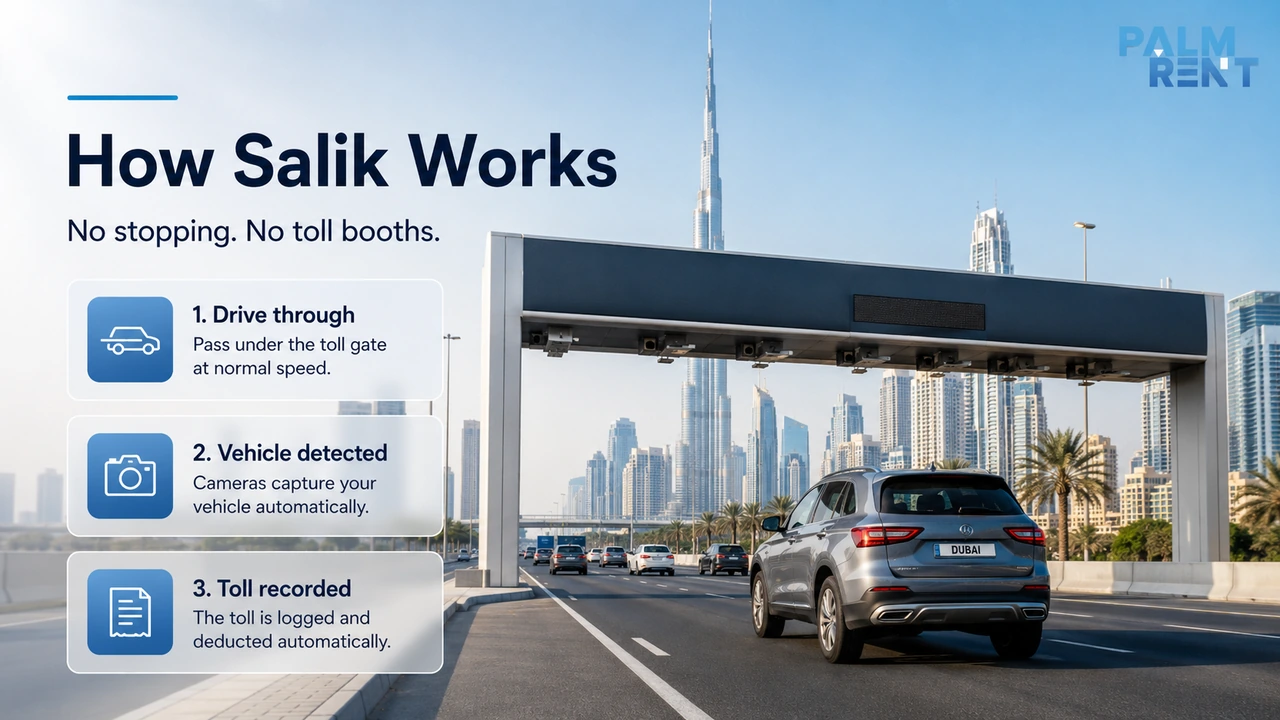
Salik is an electronic toll collection system used in Dubai. A vehicle is identified when it passes through a Salik gate, and the toll is recorded on the account linked to that vehicle. The system is designed to keep traffic moving without toll booths or stopping points.
For a privately owned vehicle, the owner is normally responsible for the Salik tag, account balance and payments. For a rental car, the vehicle is usually already connected to Salik, and toll crossings are later billed according to the rental company’s terms.
For broader driving responsibilities, traffic fines and road rules, it is useful to read the Dubai driving rules and fines page alongside this guide.
How much does Salik cost in Dubai?
Salik fees in Dubai are time-based. From Monday to Saturday, during peak hours from 6:00 AM to 10:00 AM and from 4:00 PM to 8:00 PM, the base rate is AED 6 per crossing. During off-peak hours, the base rate is AED 4 per crossing. The period from 1:00 AM to 6:00 AM is free. On Sundays, a flat AED 4 rate applies, except during the free 1:00 AM to 6:00 AM window.
From 1 June 2026, a 5% VAT applies to Salik toll crossings and tag activation fees. This means the final amount can be higher than the base toll: AED 6 becomes AED 6.30 after VAT, and AED 4 becomes AED 4.20 after VAT.
To avoid outdated information, check the official Salik variable toll rates page or the Dubai.ae Salik guide before planning routes that depend on exact timings, public holidays or Ramadan schedules.
- Peak, Monday to Saturday: 6:00 AM–10:00 AM and 4:00 PM–8:00 PM; AED 6 base rate, AED 6.30 with VAT.
- Off-peak: AED 4 base rate, AED 4.20 with VAT.
- Free window: 1:00 AM–6:00 AM.
- Sundays: AED 4 flat base rate, except the free 1:00 AM–6:00 AM window.
- VAT from 1 June 2026: 5% VAT applies to Salik toll crossings and tag activation fees.
Where are the Salik toll gates in Dubai?
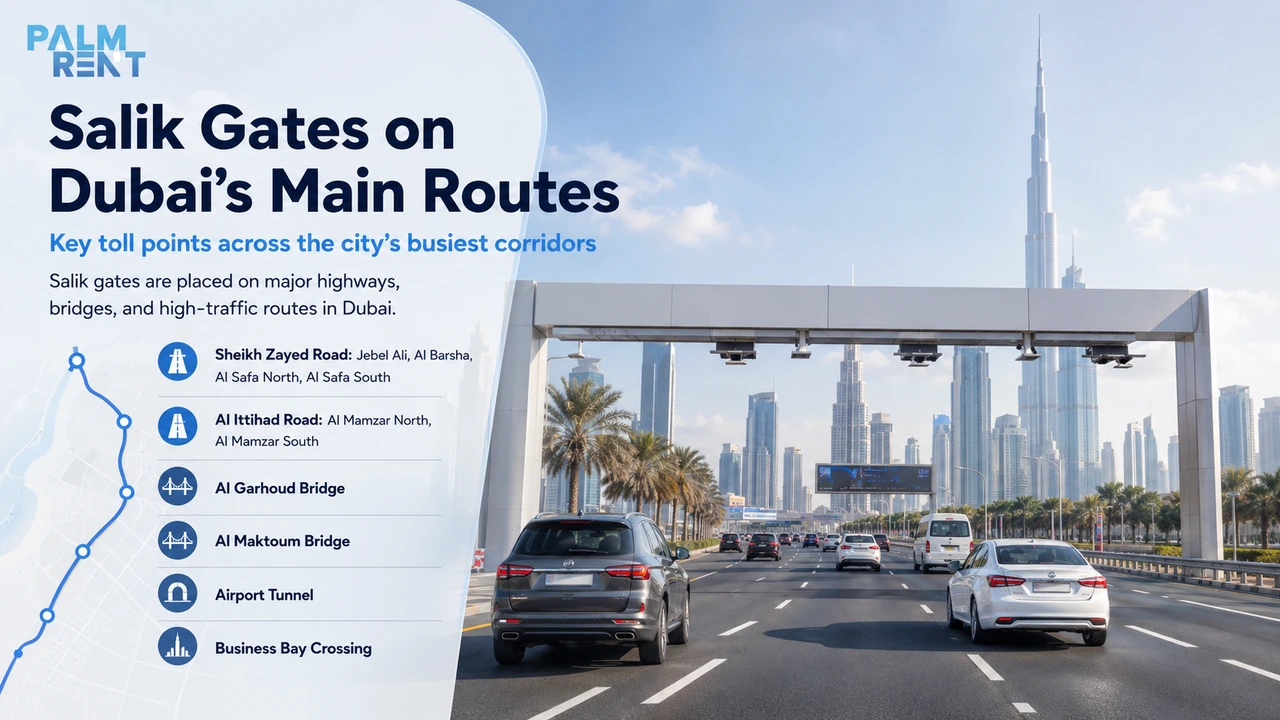
Salik does not cover every street or highway in Dubai. Charges are recorded only when a vehicle passes through specific toll gates. These gates are usually located on major routes such as Sheikh Zayed Road, Al Ittihad Road, Al Khail Road, the Airport Tunnel and key bridges.
According to official Salik information, the network includes 10 toll gates, including Al Barsha, Al Garhoud Bridge, Al Maktoum Bridge, Al Mamzar North, Al Mamzar South, Al Safa North, Al Safa South, Airport Tunnel, Jebel Ali and Business Bay Crossing.
Before driving between areas such as Downtown Dubai, Dubai Marina, Jumeirah, Deira, the airport or business districts, it is worth checking the official Salik toll gate locations page.
How is Salik billed on a rental car?
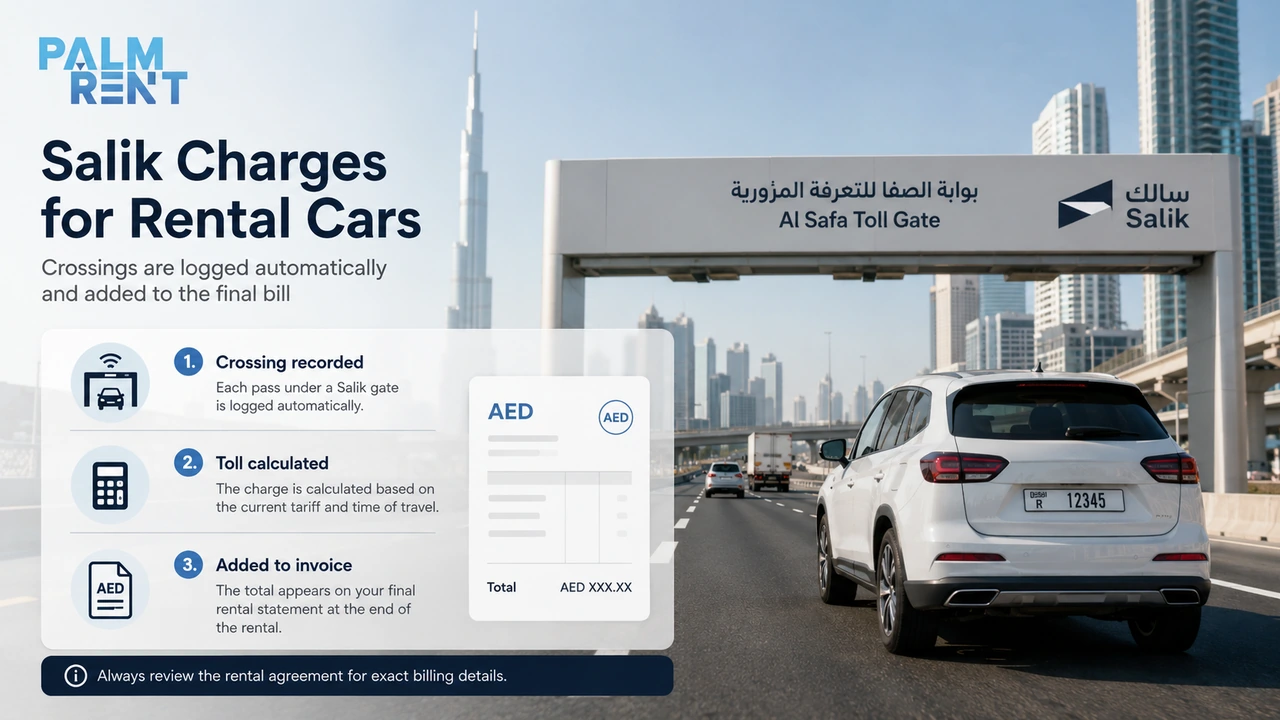
With most rental cars in Dubai, you do not need to buy a Salik tag or create a separate Salik account. The car is usually already set up for toll crossings, and each crossing is recorded automatically.
The important point is that Salik is usually charged separately from the base rental price. At the end of the rental, the number of recorded toll crossings may appear on your invoice. The exact billing method, timing, VAT and any service fee should be stated in the rental agreement.
For a wider view of route-related expenses such as parking, fuel, fines, delivery and return costs, see the guide to extra costs of a rental car in Dubai.
How to manage Salik costs wisely
The goal is not always to avoid Salik at any cost. A route without toll gates can sometimes take longer, use more fuel and become less convenient. It is better to compare the toll fee with travel time, traffic and parking conditions.
- Choose your driving time carefully: If your schedule is flexible, avoid the busiest peak periods.
- Check the route before you leave: Some alternative routes avoid toll gates but may be slower.
- Estimate repeated crossings: If you move several times between major districts in one day, tolls can add up quickly.
- Read the rental agreement: Check how Salik is billed, when it is charged and whether VAT or an admin fee applies.
- Separate Salik from traffic fines: Salik is a toll charge. Speeding, parking and other violations are separate matters.
If you are comparing car use with metro, taxi or mixed transport, the Dubai public transport guide can help you compare cost and convenience.
When can Salik-related fines happen?
Salik-related issues usually happen when a vehicle crosses a gate with an inactive account, insufficient balance or a tag/account problem. For a private car, the owner needs to make sure the account is active and funded. For a rental car, the driver should understand that tolls can be passed on according to the contract.
For details about balance, tag purchase, disputes or fines, use the official Salik frequently asked questions section. Official sources are more reliable for details that can change over time.
Private car vs rental car: what changes?
With a private car, the Salik account is normally linked to the owner and vehicle plate. The owner manages the tag, account balance and toll payments.
With a rental car, the vehicle is usually ready for Salik use. You drive through the gates, the crossings are recorded, and the rental company charges you according to the contract. When collecting the car, ask how Salik is calculated, when it is settled and whether VAT or a service fee is added.
What to check before driving in Dubai
- Does your route pass through a Salik gate?
- Are you driving during peak hours?
- Is a toll-free route actually faster or cheaper?
- If the car is rented, how does the contract calculate Salik?
- Does your destination involve paid parking, restricted parking or heavy traffic?
If your itinerary covers several areas of Dubai in one day, do not look at Salik alone. Compare traffic, parking, distance, metro access and driving comfort together. For branch and vehicle information, you can use the Palm Rent Dubai branch page as a soft planning reference.
Summary
Salik is a smooth, cashless toll system, but for visitors and new drivers it can affect the daily travel budget. The key is to know which roads have toll gates, how rates change by time, how rental cars are billed and what to check to avoid unexpected charges.
This guide helps you understand the cost and route logic, but it does not replace your rental agreement, the rules page or official Salik sources. For time-sensitive rates, always check the official source.
Frequently asked questions about Salik in Dubai
What is Salik in Dubai?
Salik is Dubai’s electronic road toll system. When a vehicle passes through specific toll gates, the crossing is recorded automatically on the account linked to that vehicle.
How much does Salik cost in Dubai?
During peak hours, the base rate is AED 6 per crossing and AED 6.30 with VAT. During off-peak hours, the base rate is AED 4 and AED 4.20 with VAT. The 1:00 AM to 6:00 AM window is free. On Sundays, a flat AED 4 base rate applies, except for the free early-morning window.
Do rental cars in Dubai have Salik?
Yes. Most rental cars in Dubai are already connected to the Salik system. Toll crossings are usually billed at the end of the rental period or according to the rental agreement.
Are all Dubai roads charged by Salik?
No. Salik applies only at specific toll gates. If your route does not pass through a Salik gate, no Salik toll is recorded for that part of the trip.
How can I reduce Salik costs?
The best approach is to check your route before driving, choose quieter times when possible and compare alternative routes. A toll-free route is not always cheaper if it takes more time and fuel.
Recommended articles to read next






Check available cars and daily rental prices
With Palm Rent, you can choose the right car for your trip or daily use with clear terms and professional support.
